


Most observers assume the future of artificial intelligence hinges on sprawling, purpose-built data centers. However, Elon Musk's latest venture isn't constructing a new technological palace it's repurposing existing infrastructure, transforming old buildings like gun ranges and warehouses into a powerful AI supercomputer. This unconventional approach, prioritizing existing space over new construction, could dramatically reshape industry standards and accelerate the development of AI.
That storytelling instinct shapes how SpaceXAI has presented its Colossus 2 supercomputer expansion a project that began with a single facility in Memphis and is now sprawling across two states, targeting more than a million AI chips by year-end. The narrative is part technical milestone, part industrial mythmaking. And it raises a set of practical questions for anyone tracking where large-scale AI compute is actually being built, paid for, and used.
This article traces those questions through the available public record, focusing on what SpaceXAI has disclosed about its plans, its current facilities, and the broader compute strategy behind the buildout.
What Is the xAI Colossus Supercomputer Expansion?
Colossus is the name used for a cluster of data centers developed by xAI a company later rebranded as SpaceX Super Intelligence, or SpaceXSI in the Memphis, Tennessee and Southaven, Mississippi area. The project began with a single facility, Colossus 1, built inside a former Electrolux plant in South Memphis. Construction of the initial cluster of approximately 100,000 Nvidia H100 GPUs was completed in 122 days, with the system going live in mid-to-late 2024. Capacity was later expanded; Epoch AI estimates the site's chips now include about 150,000 H100s, 50,000 H200s, and 30,000 B200s.
A second major facility, Colossus 2 also referred to as Macrohard was developed beginning in 2025 in the Whitehaven area of Memphis, with associated power generation across the state line in Southaven, Mississippi. Additional nearby buildings, sometimes called Minihard and Macroharder (or Colossus 3), expanded the cluster. As of mid-2026, the combined sites provided on the order of 1 gigawatt of AI compute capacity.
SpaceXAI CEO Elon Musk has described the project as "the world's largest AI supercomputer" and a "gigafactory of compute." The company positions the rapid buildout as a competitive advantage: "We were told it would take 24 months to build," SpaceXSI states on its Colossus overview page. "So we took the project into our own hands, questioned everything, removed whatever was unnecessary, and accomplished our goal in four months."
How Many GPUs Will the Colossus 2 Expansion Have?
The GPU count for Colossus 2 has been a moving target throughout 2026, with Musk disclosing progressive expansions through posts on X. The picture that emerges from multiple disclosures is one of rapid scaling.
On September 25, 2026, Musk detailed on X that the Memphis cluster then ran 550,000 Nvidia GPUs specifically 110,000 Nvidia GB200 and 440,000 GB300 chips. He outlined a three-phase expansion targeting roughly 1.21 million GPUs by year-end, adding 220,000 GB300 chips per phase over the following weeks.
By late October 2026, that roadmap had grown more granular. Musk disclosed that Macrohard the original Colossus 2 facility had 330,000 GPUs (110,000 GB200 plus 220,000 GB300), while Macroharder and Minihard each contained 220,000 GB300 GPUs configured for training, with 800 Gbps network interface cards.
Two additional facilities were announced for the end of 2026. Gun Range, named for the former police gun range SpaceXAI acquired, is planned to contain 220,000 GB300 GPUs also configured for training, matching the Macroharder and Minihard setup. Spam occupying a building that previously housed Hormel products will contain approximately 200,000 GB300 GPUs but configured for inference rather than training, requiring simpler networking and less than half the fiber of the training configurations.
Musk summed up the year-end target in an October 31, 2026 post: "a total of around 1.2M Blackwells." Converge Digest's analysis of the disclosed figures shows the capacity progression as roughly 770,000 existing GPUs, rising to approximately 990,000 after Gun Range comes online, and to about 1.19 million after Spam is operational figures that round to Musk's stated "around 1.2 million."
Where Is Elon Musk's Colossus Supercomputer Located?
The Colossus supercomputer spans two locations in the Memphis, Tennessee and Southaven, Mississippi metropolitan area. Colossus 1 is located in a former Electrolux factory in South Memphis. Colossus 2 and its associated expansions are centered in the Whitehaven area of Memphis, with power generation and additional facilities extending across the state line into Southaven, Mississippi.
The two newest facilities announced in late 2026 Gun Range and Spam are both sited in Southaven, Mississippi. Musk described Gun Range as being built on land that was "literally the local police department's gun range that we bought." Spam occupies a commercial building that previously stored Hormel food products.
SpaceXAI announced on November 2, 2026, that it is launching two additional data center campuses in Mississippi to further expand Colossus 2. Charlotte Trueman reported for Data Center Dynamics that the sites, dubbed Gun Range and Spam, would both be operational by end of the year, according to Musk.
Is SpaceX Involved in the Colossus AI Supercomputer?
Colossus was originally developed by xAI, but the company underwent a rebranding to SpaceX Super Intelligence (SpaceXSI), reflecting closer integration with SpaceX operations. The data center now falls under the SpaceXSI brand, and SpaceX personnel and contractors have been directly involved in the construction and operation of the facilities.
Musk described walking "the whole Colossus 2 site around midnight and again this morning" in an October 31, 2026 post, noting "Good progress by the SpaceX team and contractors." The buildout has been characterized as a SpaceX-led effort, with the company managing construction, power infrastructure, and facility operations.
SpaceX is also the entity renting compute capacity to external customers. On June 5, 2026, Google agreed to rent access to approximately 110,000 GPUs from SpaceX beginning October 2026 through June 2029 for $920 million per month. In May 2026, Anthropic agreed to rent essentially all compute capacity at Colossus 1. Anthropic's IPO filing disclosed that the Claude maker agreed to spend up to $120.5 billion on SpaceX AI compute through 2029.
What Is the Timeline for the Colossus 2 Expansion?
The timeline reflects a pace that Musk and SpaceXSI have consistently framed as a competitive advantage. The original Colossus 1 build approximately 100,000 Nvidia H100 GPUs was completed in 122 days, well ahead of initial projections. The subsequent expansion to 200,000 GPUs took an additional 92 days.
Colossus 2 development began in 2025, with the Macrohard facility and associated power generation coming online over the course of that year. By mid-2026, the combined Colossus 1 and Colossus 2 sites delivered roughly 1 gigawatt of AI compute capacity.
The 2026 expansion accelerated through the year. By September 2026, Musk disclosed the current 550,000-GPU baseline and outlined plans to add 660,000 more GB300 chips across the final quarter. The disclosure gave specific timelines: 220,000 chips coming online the following week, another 220,000 in November 2026, and a final 220,000 by the end of December.
The two newest facilities received more precise targets. Gun Range is tracking to be operational by the end of November 2026, with Spam expected to follow in December 2026. These are stated targets projections rather than announcements that equipment is already operational, as Converge Digest noted in its coverage.
Musk has acknowledged the aggressive timeline publicly. "I walked the whole Colossus 2 site around midnight and again this morning," he posted on October 31, 2026. "Good progress by the SpaceX team and contractors."
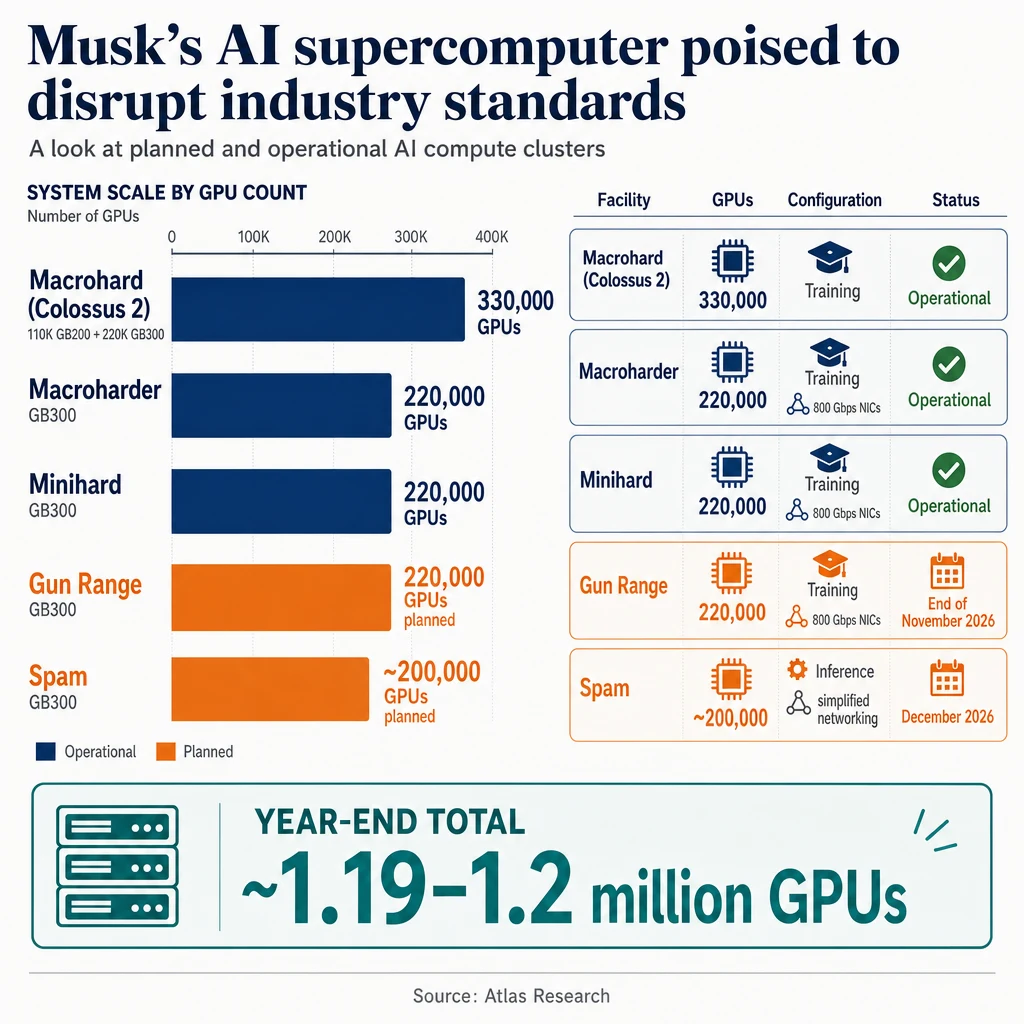
| Facility | GPUs | Configuration | Target Status |
|---|---|---|---|
| Macrohard (Colossus 2) | 330,000 (110K GB200 + 220K GB300) | Training | Operational |
| Macroharder | 220,000 GB300 | Training, 800 Gbps NICs | Operational |
| Minihard | 220,000 GB300 | Training, 800 Gbps NICs | Operational |
| Gun Range | 220,000 GB300 planned | Training, 800 Gbps NICs | End of November 2026 |
| Spam | ~200,000 GB300 planned | Inference, simplified networking | December 2026 |
| Year-End Total | ~1.19-1.2 million |
What Is the Purpose of the Colossus Supercomputer?
The Colossus supercomputer serves a dual purpose within the SpaceXSI ecosystem: internal training of the company's Grok AI models, and rental of compute capacity to external AI developers and labs.
Colossus 1's primary initial purpose was training the company's chatbot Grok. As the cluster expanded and Colossus 2 came online, training of newer Grok models shifted primarily to the newer facilities. SpaceXSI describes the compute platform as enabling the development of its Grok product line, including recent releases like Grok Voice 3.0 and Grok Bot for business applications.
Simultaneously, SpaceXSI has positioned Colossus as a compute-for-hire platform. The company has disclosed a rough internal target of approximately a 50/50 split between internal use and rental capacity, though that mix can shift month to month. The rental model helps offset the substantial cost of GPU procurement and facility construction.
The customer roster includes some of the most prominent names in AI. Anthropic agreed in May 2026 to rent essentially all compute capacity at Colossus 1, with a disclosed commitment of up to $120.5 billion through 2029. Google secured access to approximately 110,000 GPUs from October 2026 through June 2029 at a rate of $920 million per month. These agreements represent significant revenue commitments that support the continued expansion of the facility.
The inference-versus-training split at the newer facilities reflects the different computational demands of AI deployment. Training clusters like those at Macroharder, Minihard, and the planned Gun Range require dense, high-bandwidth fabric between chips. Inference the process of running trained models can operate with simpler networking, which is why Spam's design requires less than half the fiber of the training configurations.
What Are the Named Mississippi Facilities, and Why Do They Have Those Names?
The two newest facilities in the Colossus 2 expansion carry informal names that Musk has explained on social media. Gun Range takes its name from its predecessor: the site was previously a local police department gun range that SpaceXAI acquired. Musk noted the origin with characteristic humor: "It was literally the local police department's gun range that we bought," he wrote in an October 2026 post, adding a laughing emoji.
Spam occupies a commercial building that previously housed Hormel products the food company famous for its canned meat product of the same name. Musk acknowledged the potential for wordplay in the naming: "I hope Spam doesn't produce too much spam!" he posted, again with a laughing emoji.
The informal naming convention is consistent with the way Musk has described other SpaceX and xAI facilities, blending geographic or historical context with personal humor. The approach humanizes large infrastructure projects and generates social media engagement a form of informal marketing that complements the company's formal announcements.
What This Means for SpaceXAI Readers
The Colossus 2 expansion illustrates a broader pattern in large-scale AI infrastructure: the convergence of internal development and external compute rental into a single operational model. SpaceXSI is not merely building compute for its own Grok models it is constructing a platform that Anthropic, Google, and potentially other AI labs depend upon for capacity they cannot or choose not to build themselves.
For readers tracking the AI industry, this creates several practical considerations. The concentration of advanced GPU capacity in a small number of mega-facilities gives their operators significant leverage in the AI development ecosystem. The rental commitments disclosed Anthropic's $120.5 billion commitment through 2029, Google's $920 million monthly rate suggest that major AI labs view compute access as a strategic necessity, not just an operational convenience.
For those evaluating AI infrastructure more broadly, the Colossus story offers a case study in buildout velocity. Completing a 100,000-GPU cluster in 122 days, then scaling to more than a million GPUs within roughly two years, reflects a construction and procurement approach that differs substantially from traditional data center development timelines. Whether that pace can be sustained and at what cost remains an open question as the expansion continues.
Where to Read Further
For readers who want to follow the Colossus 2 expansion directly, the most timely source is Musk's own posts on X, where he has disclosed facility specs, GPU counts, and operational timelines throughout 2026. SpaceXSI's official Colossus overview page provides the company's own framing of the project as "the world's largest AI supercomputer" with specifications on the initial build.
For ongoing coverage of the Mississippi campus expansions, Data Center Dynamics has reported on SpaceXAI launching two additional data center campuses in Mississippi to further expand Colossus 2. Converge Digest's analysis of Musk's GPU roadmap for Gun Range and Spam provides detailed breakdowns of the facility configurations and capacity progression.
The Wikipedia entry for Colossus (data center) offers a comprehensive overview of the project's history, including the transition from xAI to SpaceX Super Intelligence, the environmental impact documentation, and the current status as of mid-2026. TeslaNorth has covered SpaceX's Gun Range and Spam clusters with details on Musk's naming explanations and configuration specifics.